Renewing Feminisms by Helen Thornham Elke Weissmann
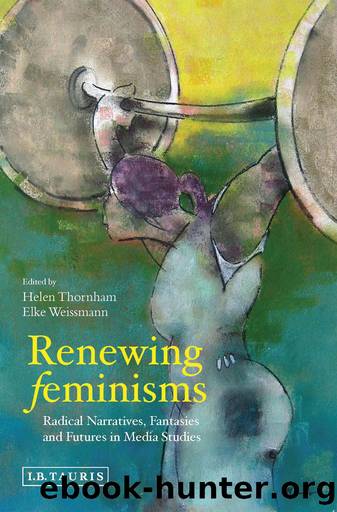
Author:Helen Thornham, Elke Weissmann [Helen Thornham, Elke Weissmann]
Language: eng
Format: epub
ISBN: 9781848858251
Barnesnoble:
Publisher: Bloomsbury Academic
Published: 2013-07-08T00:00:00+00:00
Private and Public Worlds?
Although the serial was hugely popular, it was under threat of cancellation by the Drama Department several times. The critique it faced led to several changes, and in 1952 Mrs Daleâs Diary began to transform. Measures had already been taken inside the BBC in the early 1950s to make the Diary, in their view, more topical and outward looking (in a sense, less âfeminineâ). This transformation appears to have been prompted by three incidents: first, changes to the editorial policy; second, increasing competition; and third, reorganization in the production, with the appointment of a âfixedâ male producer and a male scriptwriter.
The first change to the serial can be seen in the editorial policy. According to the critics within and outside the BBC, the characters in the serial, overall, lacked an interest in the âoutsideâ world â for instance, topical events and politics â which to them implied vagueness about their social status: they did not behave as middle-class people. In 1950 an outside commentator was commissioned to produce an independent report on the serial, focusing on the social status of the family. In the finished report was this highlight: âthe fact that they [the characters] make no comment on any events of the day â either sport, theatre, films, music or politics, or anything other than local details â tends to produce a feeling that they are isolated from the normal features which play a part in other peopleâs lives.â28 It was further clear that the familyâs geographical location and neighbourhood implied certain status (middle class), but the familyâs behaviour did not comply with this, since such important details as religion, community relationships, sport, politics â the elements or parts that are defined by a familyâs social status â were absent. The report also coincided with a plea from the scriptwriters, Lesley Wilson, Jonquil Anthony and Joan Carr-Jones, for a change in policy. The strict editorial policy set out in 1949 had made it clear that characters should remain âpermanentâ â not allowed to change, remaining âmentally, physically and spiritually intact â the same people, in the same stage of development, tied to the same background, inhibited by the same hopes and fears with which they were introduced.â29 This was not feasible from a creative point of view, as the scriptwriters pointed out: listeners would find it unnatural and not representative of a âreal-lifeâ family to not progress.30 The report and the plea resulted in small policy changes; for example, references to cinema and books and Mrs Daleâs activities on various committees, such as the Womenâs Voluntary Services, were introduced.31
The second influence on the serial was the competition it faced from The Archers. In 1952 it was evident that The Archers had taken over in popularity, with a listening figure double that of Mrs Daleâs Diary.32 The Archers, a domestic serial about a farming community, was introduced on the Light Programme in January 1951; it was first broadcast in the morning but later at 6:45 p.m. Significantly
Download
This site does not store any files on its server. We only index and link to content provided by other sites. Please contact the content providers to delete copyright contents if any and email us, we'll remove relevant links or contents immediately.
| Anthropology | Archaeology |
| Philosophy | Politics & Government |
| Social Sciences | Sociology |
| Women's Studies |
Cecilia; Or, Memoirs of an Heiress — Volume 1 by Fanny Burney(32562)
The Great Music City by Andrea Baker(32023)
Cecilia; Or, Memoirs of an Heiress — Volume 2 by Fanny Burney(31959)
Cecilia; Or, Memoirs of an Heiress — Volume 3 by Fanny Burney(31945)
We're Going to Need More Wine by Gabrielle Union(19053)
All the Missing Girls by Megan Miranda(16050)
Pimp by Iceberg Slim(14522)
For the Love of Europe by Rick Steves(14174)
Bombshells: Glamour Girls of a Lifetime by Sullivan Steve(14081)
Norse Mythology by Gaiman Neil(13376)
Talking to Strangers by Malcolm Gladwell(13376)
Fifty Shades Freed by E L James(13247)
Mindhunter: Inside the FBI's Elite Serial Crime Unit by John E. Douglas & Mark Olshaker(9348)
Crazy Rich Asians by Kevin Kwan(9297)
The Lost Art of Listening by Michael P. Nichols(7509)
Enlightenment Now: The Case for Reason, Science, Humanism, and Progress by Steven Pinker(7316)
The Four Agreements by Don Miguel Ruiz(6770)
Bad Blood by John Carreyrou(6626)
Weapons of Math Destruction by Cathy O'Neil(6284)
